
What Is the Difference Between Assisted Living and Nursing Home Care for Seniors?

When a parent starts needing a little more help around the house, or when safety at home becomes a real concern, one of the first questions families ask is: What is the difference between assisted living and nursing home care?
And honestly, it's a fair question. Most people use these two terms like they mean the same thing. They don't.
Choosing the wrong option can mean your loved one ends up in a clinical, hospital-like setting when they could have been thriving in a warm, active community. Or the flip side, where someone with serious medical needs ends up somewhere that isn't equipped to handle them.
So let's dig into what actually separates these two care models, who each one is built for, and how to figure out which one fits your family's situation.
The Core Difference: Independence vs. Medical Intensity
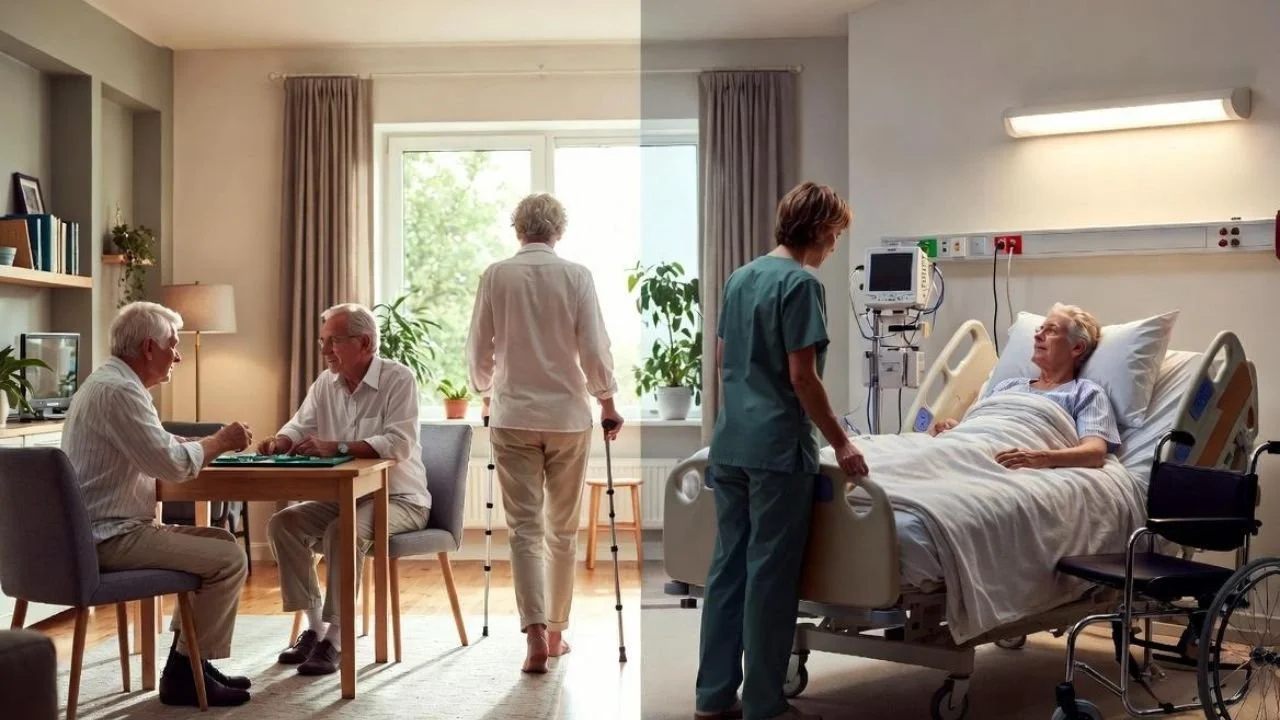
Here's the simplest way to think about it.
Assisted living is designed for seniors who are able to maintain some level of independence but need help with daily tasks, such as bathing, grooming, and dressing. Think of it less like a facility and more like a supportive community.
Residents have their own apartments, join activities, eat meals together, and live something that feels genuinely close to normal life.
Nursing homes, also called skilled nursing facilities, provide a wide range of health and personal care services. Their services focus more on medical care than most assisted living facilities.
The environment tends to be clinical. Licensed physicians supervise care plans, and medical staff are on site around the clock to manage complex or chronic health conditions.
Assisted living communities encourage and foster independence for people with a range of abilities. Nursing homes, by contrast, cater to people with complex and highly demanding health needs, including conditions like severe dementia or significant mobility impairments where independent functioning simply isn't possible.
So the question isn't really "which is better." It's which one matches what your loved one actually needs right now.
Who Is Each Option Built For?
Assisted Living is typically a strong fit when:
The senior needs some help with daily activities (bathing, dressing, medication management) but is otherwise fairly healthy.
There's a desire to stay socially active and maintain a lifestyle, not just receive care.
Safety at home has become a concern, but full-time medical supervision isn't necessary.
Family members are stretched too thin to serve as the primary caregiver.
Nursing Home care tends to be more appropriate when:
There's a complex, chronic medical condition that needs 24/7 monitoring.
Recovery after surgery or hospitalization requires skilled nursing or physical therapy.
The individual needs tube feeding, wound care, or other intensive medical interventions
Cognitive decline has reached a stage where specialized, round-the-clock supervision is required.
Assisted living is a great choice for seniors who cannot safely live alone but want to maintain an active lifestyle. They can stay active and independent while benefiting from support with daily activities like dressing, bathing, cleaning, or using the toilet.
If you're wondering whether your loved one is showing early signs that assisted living might be the right next step,5 Signs It May Be Time for Assisted Living can help you think it through.
Side-by-Side Comparison
Feature: Level of medical care
Assisted Living: Supportive, not clinical
Nursing Home: High intensity, 24/7
Feature: Living environment
Assisted Living: Apartment-style, home-like
Nursing Home: Clinical, hospital-like rooms
Feature: Independence
Assisted Living: Encouraged and maintained
Nursing Home: Limited by medical needs
Feature: Social activities
Assisted Living: Robust activity calendar
Nursing Home: Less emphasis, limited by condition
Feature: Staffing
Assisted Living: Trained aides, on-site support
Nursing Home: Licensed nurses, physicians on call
Feature: Who it's for
Assisted Living: Active seniors needing ADL help
Nursing Home: Those with chronic or complex illness
Feature: 2025 median monthly cost
Assisted Living: ~ $6,077
Nursing Home: $9,555 to $10,965
The Real Cost Difference (And It's Significant)
In 2025, the median cost for a nursing home ranges from $9,555 to $10,965 per month, depending on the room type, while the median for assisted living is around $6,077 per month. That gap is massive, and it compounds fast over months or years of care.
Here's something many families don't realize until it's too late: Medicare does not cover assisted living, so most people pay for it out of pocket or with help from limited coverage provided by long-term care insurance. Nursing homes get somewhat more Medicare coverage, but mainly for short-term recovery stays, not long-term residency.
Cost factors that affect both options include:
Location (urban vs. rural, cost of living in the area)
Room type (private vs. shared)
Level of care (how much daily assistance is needed)
Amenities (what programs, services, and spaces are included)
The takeaway? If a senior doesn't need intensive medical care, paying nursing home rates is often both unnecessary and financially draining.
What Services Does Each Option Actually Provide?
Both settings offer some overlap. But the focus is very different.
Services typically available in Assisted Living:
Help with ADLs (Activities of Daily Living) like bathing, dressing, and grooming.
Medication management
Three meals a day, often restaurant-style
24-hour supervision and emergency response
Housekeeping and laundry
Social activities, fitness programs, wellness events
Transportation assistance
Memory care programs (at many communities)
Assisted living services are geared toward those who may need some support from staff, along with meals and socialization. Therefore, these facilities focus on many different types of activities and entertainment.
Services typically available in Nursing Homes:
Skilled nursing care (licensed nurses on duty at all times)
Physician-supervised care plans
Physical, occupational, and speech therapy
Management of complex chronic conditions
Wound care, tube feeding, and other medical interventions
Rehabilitation after surgery or hospitalization
Skilled nursing facilities have 24-hour care for seniors with more complex medical issues, including those who may need more hands-on assistance and constant medical monitoring. Some residents who need skilled nursing care may rely on tube feeding or may be confined to bed.
Licensed physicians supervise the care, and a nurse is available around the clock. Nursing homes may also have the same medical equipment found in hospitals, such as adjustable electric beds and X-ray machines.
The Environment: What Daily Life Actually Looks Like
This part matters more than people give it credit for.
Residents in assisted living communities often have private apartments or shared rooms with access to common areas for social activities, promoting a home-like atmosphere. In contrast, nursing homes typically have a more clinical setting with hospital-like accommodations.
In assisted living, your parents might have their own apartment with familiar furniture, join a yoga class in the morning, have lunch with friends in a dining room that looks nothing like a cafeteria, and participate in a game night in the evening. Life keeps moving. It doesn't stop at the door.
Assisted living communities promote more independence in their residents by offering help with activities of daily living such as bathing, dressing, and grooming. The focus extends well beyond health and safety to include meaningful activities and quality relationships.
In a nursing home, the rhythm of the day is shaped around medical schedules. That's not a criticism. For people who genuinely need that level of care, it's exactly right. But it's a fundamentally different experience, and if a senior doesn't need that level, it can feel unnecessarily restrictive.
For families considering a move during Duluth's colder months, it's also worth understandingwhy assisted living is a safer and more practical option during winter compared to managing at home alone.
When It's Time to Move from Assisted Living to a Nursing Home
Assisted living isn't necessarily forever. Sometimes health changes and a higher level of care becomes necessary. Signs that the transition might be needed include:
Significant decline in ability to perform daily activities without major assistance
Frequent hospitalizations or medical emergencies
Need for skilled nursing interventions like daily wound care or IV medications
Loss of mobility requiring constant repositioning or specialized equipment
The key is staying in close contact with the care team so these transitions happen proactively, not reactively.
If the family is currently at the stage of evaluating the shift from independent to assisted living rather than nursing home,this guide on moving from independent to assisted living covers the key differences and considerations worth knowing.
How to Choose What's Right for Your Loved One
Start with an honest assessment of where things stand today, and where they might realistically be in 12 to 24 months. A few questions worth sitting with:
Does your loved one need help with daily tasks but is otherwise mobile and mentally engaged?
Is the main concern safety at home rather than a specific medical condition?
Does your loved one value independence, social connection, and staying active?
Is full-time medical supervision something a doctor has specifically recommended?
As a first step, always defer to an assisted living assessment before making a decision. The assessment process is the first step in helping people choose whether an assisted living community or a nursing home facility is best for them. Plus, an assessment can help someone live life with as much independence as possible and give the confidence to choose the least restrictive environment possible.
Get the physician involved. Get an assessment done. And if possible, tour the communities before deciding anything.
FAQs
1. What is the difference between assisted living and nursing home care in simple terms?
Assisted living provides help with daily activities, while nursing homes offer full time medical care and supervision.
2. Is assisted living cheaper than a nursing home?
Yes, assisted living is generally more affordable because it involves less intensive medical care.
3. Can someone move from assisted living to a nursing home later?
Yes, many seniors transition to nursing homes if their health needs increase over time.
4. Which option is better for seniors with dementia?
It depends on the severity. Mild cases may work in assisted living, while advanced cases usually require nursing home care.
Keystone Bluffs: Assisted Living in Duluth, MN
For families in the Duluth area navigating this decision,Keystone Bluffs Assisted Living offers a warm, thoughtfully designed community where seniors can genuinely thrive. Located at 2528 Trinity Road, Keystone Bluffs features 80 apartment-style residences all on one floor, a full activities calendar, professional on-site support, beautiful shared spaces, and a team that takes the time to actually get to know each resident.
If your loved one needs some support with daily living but doesn't require intensive medical care, assisted living at Keystone Bluffs could be exactly what this next chapter calls for.
Schedule a tour today and see the difference for yourself.