
How Walk-In Showers in Assisted Living Help Prevent Senior Falls
There's a moment families rarely talk about when they're touring assisted living communities. They walk past the dining room, peek at the activity calendar, and admire the courtyard. But it's often the bathroom that quietly matters most. Because statistically, that's where the real danger hides.
More than a third of seniors over the age of 65 slip and fall each year, and 80 percent of those falls occur in the bathroom. That number is hard to sit with. It means the most familiar, routine part of someone's day, stepping in for a shower, is also one of the riskiest moments they'll face.
And for families choosing an assisted living community, that fact changes what they should be looking for.
Why the Bathroom Is the Most Dangerous Room for Seniors
Most people don't picture the bathroom when they think about fall hazards. They picture icy sidewalks or uneven curbs. But the data tells a different story.
Approximately two thirds of all bathroom injuries occur in the tub or shower, and roughly half are caused by bathing or showering, slipping, or getting out of the tub or shower. CDC Getting out of the shower. Not climbing Everest. Not crossing a busy street. Just stepping out of a tub.
Almost one-third of adults aged 65 and above who were injured in bathrooms are diagnosed with fractures, and among adults aged 85 and older, 38 percent are hospitalized as a result of their injuries.
These aren't minor bumps. They're life-altering events.
Understanding the Real Risk Factors for Falls in the Elderly
Before talking about solutions, it helps to understand why seniors are so vulnerable in the first place. The risk factors for falls in the elderly are rarely just one thing.
Physical and Health-Related Factors
Muscle weakness, especially in the legs, reduces stability and the ability to catch a stumble.
Balance and gait changes that come naturally with aging
Vision decline affects depth perception, making it harder to judge a wet floor or a step edge.
The risk of falls actually doubles if an older adult has any level of vision impairment.
Postural hypotension, a sudden drop in blood pressure when standing up, causes dizziness and is a well-documented fall trigger.
Urinary incontinence creates urgency that makes people rush to the bathroom, often at night, under low light.
Medication-Related Factors
Many seniors manage multiple conditions simultaneously. The medications that help them do that can also create real problems. Dizziness, drowsiness, confusion, and sudden drops in blood pressure are all documented side effects of common prescriptions. The more medications someone takes, the higher the compound risk.
Environmental Factors
This is where the design of a facility matters enormously.
Poor lighting, the presence of stairs, sliding glass doors, tubs with high step-over entries, shower curtains, and towel bars placed near entryways have all been identified as unsafe environmental features that increase fall risk for older adults.
Traditional bathtubs with high sidewalls are particularly problematic. Stepping over that ledge requires balance, leg strength, and spatial awareness that many seniors simply no longer have. It's not about frailty. It's about physics working against an aging body.
The Problem With Traditional Bathtubs
Here's the thing: most people don't think about it until it's almost too late. A standard bathtub was designed for able-bodied adults in their thirties and forties. The high step-over entry, the sloped porcelain floor, the awkward position required to get in and out, none of that was built with a 78-year-old in mind.
And assisted living communities that still rely on traditional tubs are asking residents to navigate a design that simply wasn't made for them.
That's a safety gap that walk-in showers were specifically engineered to close.
How Walk-In Showers Reduce Fall Risk
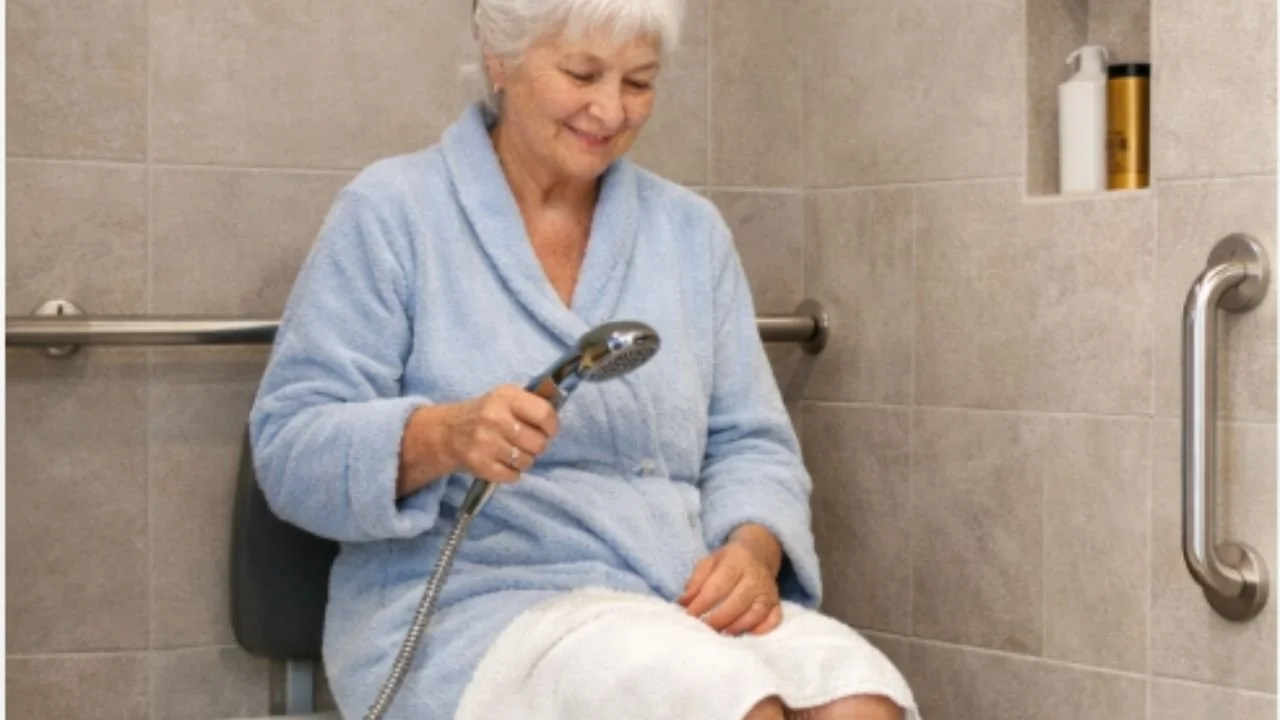
Walk-in showers address multiple risk factors at once. That's what makes them so effective, not just as a comfort feature but as genuine fall prevention infrastructure.
Safety Feature: Zero-threshold or low-threshold entry
How It Reduces Fall Risk: Eliminates the dangerous step-over that causes most tub-related falls
Safety Feature: Non-slip flooring
How It Reduces Fall Risk: Reduces slipping on wet surfaces
Safety Feature: Built-in or fold-down shower seat
How It Reduces Fall Risk: Allows bathing while seated, reducing fatigue and balance demands
Safety Feature: Grab bars positioned at entry and interior
How It Reduces Fall Risk: Provides secure support when entering, bathing, and exiting
Safety Feature: Wider footprint
How It Reduces Fall Risk: Allows use with walker or wheelchair without restriction
Safety Feature: Better lighting options
How It Reduces Fall Risk: Reduces visual hazards in wet environments
Safety Feature: Open design
How It Reduces Fall Risk: No need to maneuver around a tub rim or curtain rod
Shower seats, grab bars in the shower and near the toilet, ramps, and ground-floor bathroom locations have all been found to promote safer home environments for older adults. Walk-in showers integrate almost all of these features into one cohesive design.
The seated bathing option alone is significant. Standing in a wet shower while washing hair requires balance that many seniors don't have consistently, and fatigue makes it worse. A fold-down bench or built-in seat turns a high-risk activity into a calm, controlled one.
Walk-In Showers and Dignity: The Part People Don't Say Out Loud
Safety is the headline. But there's something underneath it that families feel even more deeply when they walk into a well-designed assisted living bathroom.
When a bathroom is designed for the people who actually use it, seniors don't need as much help getting through a simple shower. They can move independently. They don't have to ask someone to assist with entry.
They're not negotiating a tub ledge while someone stands nearby. That independence, even in something as small as a daily shower, is profoundly important for quality of life.
Communities that invest in walk-in showers aren't just reducing injury rates. They're communicating something to residents: we designed this space for you.
What Families Should Look for When Touring Assisted Living
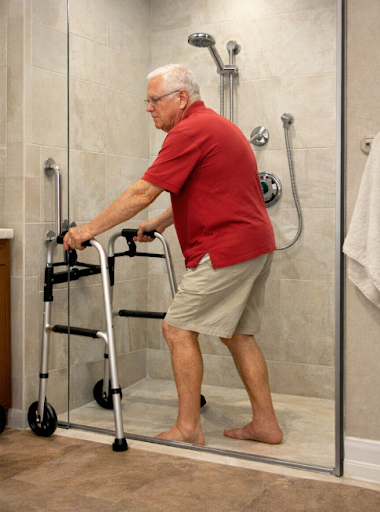
When touring a community, the bathroom is worth a real look. Not just a glance. Ask specific questions.
Key bathroom safety features to evaluate:
Is the shower entry barrier-free or low-threshold?
Are grab bars installed inside the shower and at the entry point?
Does the shower floor have a genuine non-slip surface or just a rubber mat thrown in as an afterthought?
Is there a seating option integrated into the shower design?
Is the space wide enough to accommodate a walker or wheelchair?
Is the lighting adequate, including for nighttime use?
Are bathroom fixtures accessible without awkward reaching or bending?
Among falls inside the home, those in the bathroom were significantly more likely to result in injury compared to other rooms, which means these aren't optional amenities. They're foundational safety decisions.
What the Numbers Really Tell Us
Each year, about 3 million older adults visit the emergency department due to falls, and more than 1 million are hospitalized. In 2021, falls led to more than38,000 deaths in adults aged 65 and older, according to the CDC.
Read that again. 38,000 deaths. In a single year.
The annual financial medical toll of falls among adults 65 and older is expected to exceed $101 billion by 2030, according to the National Council on Aging. That's a staggering figure. But behind every statistic is someone's parent, someone's spouse, someone who deserved a safer bathroom.
The good news is that environmental design changes genuinely work. They're not just feel-good upgrades. They prevent real injuries.
How Keystone Bluffs Approaches Bathroom Safety
AtKeystone Bluffs Assisted Living in Duluth, walk-in showers are a standard feature across all 80 thoughtfully designed apartments, not an upgrade, not an add-on. They're built into the foundation of how the community thinks about resident safety and independence.
The decision to include safe, accessible bathrooms as a core amenity reflects a straightforward belief: exceptional care starts with the details that families often overlook on a first tour but feel deeply grateful for every single day afterward.
For families in the Duluth area who are navigating assisted living decisions, these aren't small considerations. A bathroom designed around the real risk factors for falls in the elderly can be the difference between a fall that changes everything and a morning shower that is simply, peacefully unremarkable.
And that's exactly what every resident deserves.
Interested in seeing Keystone Bluffs in person?Schedule a tour and see how every detail of our community, including our walk-in showers, is designed with your loved one's safety and dignity in mind.
FAQs
1. Are walk-in showers really safer than traditional tubs for seniors?
Short answer. Yes.
But not because they look modern or stylish. They remove the most dangerous movement in the bathroom, which is stepping over a high tub wall on a wet surface. That one motion combines balance, strength, coordination, and traction. If even one of those is off that day, a fall can happen.
Walk-in showers reduce that risk immediately. Add grab bars, slip-resistant flooring, and proper lighting and the safety difference becomes very real. Especially for seniors with multiple risk factors for falls in the elderly.
2. Do walk-in showers completely eliminate the risk of falls?
No bathroom design can eliminate risk entirely. That would be unrealistic.
What they do is significantly lower the odds. Falls often happen because of small obstacles layered together. Wet floor. Weak legs. Poor lighting. No support nearby. Walk-in showers remove several of those layers at once.
And when design is combined with staff support in assisted living, the protection becomes stronger. Prevention works best when it is intentional.
3. Should families look at bathroom design when choosing assisted living?
Absolutely. And this is where many families overlook critical details.
Dining menus and activity calendars are easy to notice. Bathroom safety features are not always obvious. But they tell you a lot about how seriously a community takes fall prevention.
Ask about shower entry height. Ask about grab bar placement. Look at the flooring texture. These are not small things. They directly affect the risk factors for falls in the elderly and influence long-term independence.